
2026 guide
How to Get Your Business Recommended by ChatGPT (2026 Guide)
A practical guide for small businesses that want to be found, understood and recommended by AI.
launchAEO editorial team · 10 November 2026
More customers are turning to ChatGPT and other AI assistants when they need a product, a service or a local business.
Instead of searching through a list of websites, they might ask:
- Can you recommend a reliable plumber near me?
- Who's a good accountant for a small limited company?
- Where should we go for Sunday lunch?
- What's the best local garage for an MOT?
- Which company can help my business get found by AI?
The answer might mention several businesses, explain why they're relevant and provide links to supporting sources.
But what happens if your business isn't mentioned?
You could have an excellent reputation, years of experience and a perfectly good website, yet still be missing from the answers potential customers see.
The good news is that there are practical steps you can take to make your business easier for AI systems to discover, understand and consider.
This guide explains what matters, what you can improve yourself and how to check whether you're making progress.
Can you actually get your business recommended by ChatGPT?
Yes, businesses can appear in ChatGPT recommendations, but there is no guaranteed way to make ChatGPT recommend a particular company.
When ChatGPT uses web search, it can retrieve information from websites and other online sources to help answer a user's question.
For example, someone looking for a local electrician might receive recommendations informed by relevant business websites, public listings and other accessible sources.
The businesses mentioned can vary depending on the question, location, available information and the way ChatGPT searches for an answer.
There is no public application form that guarantees your business a place in ChatGPT's recommendations.
You cannot simply add a line to your website telling ChatGPT to recommend you and expect it to work.
What you can do is improve the information AI systems have available when evaluating your business.
That means making your website accessible, explaining your services clearly, establishing a consistent business identity and providing credible evidence of what makes you worth considering.
Think of it this way: your website needs to do more than exist. It needs to help someone — or an AI assistant — understand who you are, what you offer, where you operate and why you're relevant.
How does ChatGPT find businesses to recommend?
ChatGPT can answer questions using information learned during model training. It can also use web search to retrieve more current information when that capability is available and appropriate.
When someone asks for a business recommendation, the process may involve finding relevant sources, interpreting their contents and producing an answer suited to the question.
OpenAI does not publish a complete formula for how businesses are selected or ranked in recommendations.
However, several practical factors can affect whether your business is easy to discover and accurately describe.
1. Your website must be accessible
If a crawler cannot reach your website, it may be unable to retrieve the information you've published.
OpenAI operates OAI-SearchBot to help discover content for ChatGPT Search. Website owners can permit this crawler through their robots.txt settings and hosting infrastructure.
A website returning errors, blocking relevant crawlers or hiding important information behind login screens creates unnecessary obstacles.
What to check: Can a crawler access your public pages, and does the returned HTML contain meaningful information about your business?
You can check the technical foundations of your website with a free launchAEO audit.
2. Your business needs a clear identity
Imagine your website says: “We provide quality solutions at competitive prices.”
That could describe almost any business.
Now compare it with: “We're a family-run plumbing company serving Bristol and Bath, specialising in boiler repairs, bathroom installations and emergency plumbing.”
The second description gives a reader much more useful information. It identifies the type of business, services offered and geographic coverage.
Your website should make it easy to establish:
- Your business name.
- Your main products or services.
- The areas you serve, if relevant.
- Whether customers visit you, you visit them or you operate online.
- How customers can contact you.
- What distinguishes your business from alternatives.
This information should appear naturally in visible website content, not only in hidden metadata.
3. Your claims need supporting evidence
A business claiming to be “the best” is making a statement about itself.
A business displaying relevant qualifications, genuine customer feedback, completed work and independently verifiable credentials gives people more information to assess that claim.
Useful evidence varies by industry.
A Gas Safe registered heating engineer might display their registration details. An electrician might provide relevant NICEIC or other competent-person scheme credentials. A restaurant might publish its menu, location and links to independent customer reviews.
These details do not guarantee an AI recommendation. They help establish what the business does and provide information that can be checked.
4. Your website needs to answer real customer questions
Many business websites explain who the company is but fail to answer the questions customers ask before buying.
A builder's website might list “extensions” as a service without explaining the types of extensions offered, the areas covered or what the process involves.
A more useful page might answer: “Can you build a single-storey kitchen extension in Leeds?”
It could explain the service, show relevant projects, discuss practical considerations and provide a way to request a quotation.
That page helps potential customers directly. It also provides clearer information for search systems to interpret.
5. Your wider online presence matters
Your website is the centre of your business's online identity, but it isn't the only place information about you appears.
Public profiles, relevant directories, independent reviews and industry registrations may provide additional evidence.
For a local restaurant, that could include its Google Business Profile and Tripadvisor listing. For an online company, it might include a relevant company record, professional profile or credible industry publication.
The objective isn't to register on hundreds of directories.
It's to establish a small number of accurate, relevant and trustworthy public references that support the information on your own website.
Step 1: Check whether AI can read your website
Before changing your content, find out whether your website has technical problems.
A visually attractive website can still contain issues that make information harder for automated systems to retrieve or interpret.
Start by checking:
- Crawlability: Can relevant crawlers reach the website?
- Page content: Are your services and business details available in readable HTML?
- Page structure: Do pages use descriptive headings and logical sections?
- Business identity: Is it clear who operates the website?
- Structured data: Does the website provide appropriate machine-readable information where useful?
- Technical problems: Are broken pages, server errors or other issues interfering with access?
You don't need to become a technical SEO expert to start investigating these questions.
Start with a free AI readiness audit
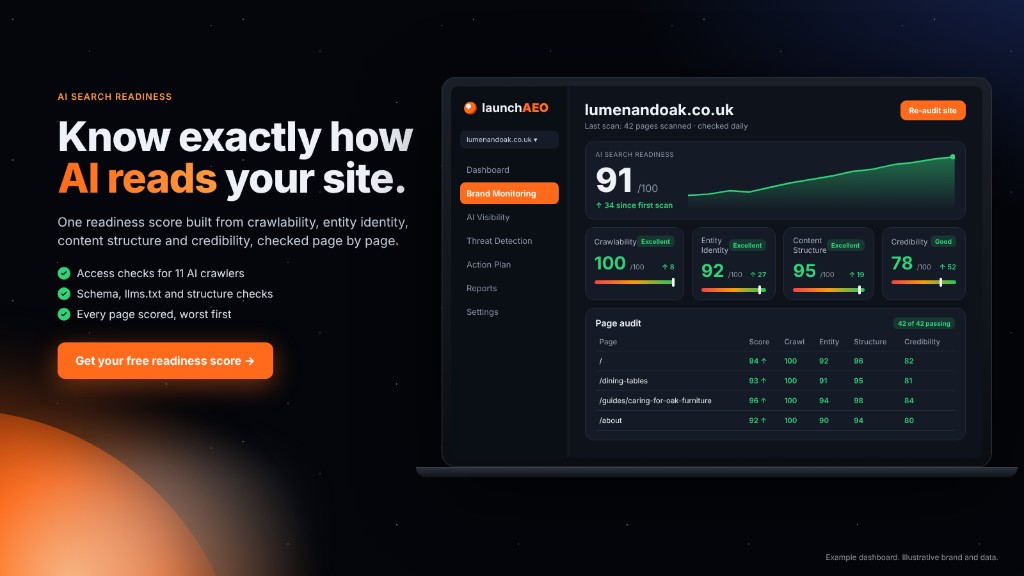
launchAEO is designed to help business owners understand how ready their websites are for AI search without requiring specialist SEO knowledge.
Its free website audit provides an AI Search Readiness score and examines areas including crawlability, business identity, content structure and credibility signals.
Rather than presenting only a score, launchAEO provides explanations of the findings and an action plan showing what to investigate or improve.
That gives you a starting point before spending money on website changes that might not address the actual problems.
Step 2: Make it obvious what your business does
One of the simplest improvements is also one of the most overlooked: explain your business in ordinary language.
Your homepage should answer three questions quickly: What do you do? Who do you help? Where do you operate?
For example, instead of “Professional services delivered with excellence,” try:
“Independent accountants helping small businesses and sole traders in Manchester with bookkeeping, VAT returns and annual accounts.”
The second version is specific enough to be useful to someone looking for those services.
You should also create dedicated pages for your important services.
A roofing company might have separate pages covering roof repairs, flat roofing, guttering and emergency leak repairs. Each page should provide genuinely useful information about that service, rather than repeating the same sales copy with a different heading.
For businesses serving multiple locations, describe actual service coverage and provide locally relevant details. Avoid generating dozens of near-identical location pages simply to target more search terms.
A useful test: if someone landed on one page without seeing your homepage, could they understand what you offer and whether you're suitable for them? If the answer is no, that page probably needs work.
Step 3: Understand the difference between local and online businesses
This distinction is important because the evidence relevant to a physical business is not always relevant to an online-only company.
If you operate a local business
A plumber, dental practice, garage, restaurant or local shop generally needs to establish where it operates. Relevant information may include:
- Business name and contact details.
- Genuine business location or service area.
- Accurate opening hours.
- Relevant Google Business Profile.
- Customer reviews.
- Services available at that location.
- Appropriate local business structured data.
For example, if someone asks ChatGPT for a dentist in Birmingham, location and the services offered are central to the question. A dentist in another city might be excellent but irrelevant to that particular request.
If your business operates entirely online
An online software company, remote consultancy or ecommerce brand has different requirements. It may not have a customer-facing physical location or qualify for a Google Business Profile. Instead, useful signals might include:
- A clear company identity.
- Detailed product or service information.
- Transparent contact and support details.
- Relevant public company or professional profiles.
- Independent product reviews or customer evidence.
- Consistent descriptions across the website and public profiles.
An online business shouldn't be treated as though it's a high-street shop simply because a website audit uses local SEO criteria.
Why the distinction matters
A missing shop address might be a serious issue for a restaurant, but completely normal for an online-only business.
Similarly, a missing Google Business Profile isn't automatically a problem for a business that isn't eligible for one.
launchAEO distinguishes between local and online businesses in its reviews and listings assessment, so recommendations can be interpreted in the context of the business being audited.
Check your business's AI readiness for free.
Step 4: Give AI useful reasons to mention your business
A website saying “we offer great customer service” gives very little evidence.
A website that explains its experience, services and relevant credentials gives potential customers something meaningful to assess.
Consider what a customer would need to know before trusting your business.
For tradespeople
Show the types of work you carry out, locations covered, relevant registrations and examples of completed projects. If you are a Gas Safe registered engineer, provide accurate registration details. If you are an electrician, describe the qualifications and certifications relevant to your actual work. Do not claim credentials you don't hold. See AI visibility for trades.
For restaurants and hospitality businesses
Publish current menus, opening hours, booking information, location details and genuine photographs. Independent customer reviews and relevant hospitality listings can provide additional context. See restaurants.
For professional services
Explain who you work with, which services you provide and the qualifications or regulatory status relevant to your profession. An accountant might explain the types of businesses they support and their professional membership where applicable. A solicitor might clearly identify the areas of law they practise and provide accurate regulatory information.
For online businesses
Explain the product, who it is designed for, what it costs and how it works. Provide documentation, examples, customer support information and evidence that helps buyers evaluate the offering.
The principle is simple: make your claims specific, useful and verifiable. Don't manufacture testimonials, exaggerate credentials or publish unsupported performance statistics in the hope of influencing AI systems.
Step 5: Structure your website around the questions customers ask
Think about the questions people ask before choosing a business.
For a plumber:
- Do you repair combi boilers?
- Can you fix a leaking pipe in an emergency?
- Which areas do you cover?
For an accountant:
- Can you help a limited company with VAT?
- Do you work with freelancers?
- How much does bookkeeping cost?
For a restaurant:
- Do you have vegetarian options?
- Can we book a table for eight?
- Are you open on Sunday evenings?
Your website should answer the questions that genuinely apply to your business.
How to create useful answer-focused content
Start with a clear heading that describes the question or service.
Answer the question directly in the opening paragraph.
Then provide the detail someone needs to make a decision, such as availability, limitations, relevant experience, typical processes or next steps.
Use descriptive subheadings and lists when they make information easier to follow.
Avoid creating pages that exist only to repeat a keyword.
You don't need to mention ChatGPT in every heading or fill your website with phrases such as “AI-friendly business.”
The objective is to publish genuinely helpful information that customers and search systems can understand.
Should you add an FAQ section?
Yes, when customers have real questions that deserve clear answers.
But FAQs aren't a shortcut to getting recommended by AI.
They work best when they provide useful information that isn't already answered elsewhere on the page.
Step 6: Check your business listings and online identity
Search for your business name and see what information appears across the web.
Are your details accurate? Do public profiles describe the same business?
Are old addresses, outdated telephone numbers or abandoned profiles creating confusion?
For local businesses, pay particular attention to your Google Business Profile and relevant industry listings. For online companies, look at credible company records, professional profiles and platforms customers actually use to evaluate businesses like yours.
Which directories should you join?
Choose directories based on relevance, legitimacy and whether they help customers find or verify your business.
A restaurant may benefit from hospitality listings. A professional practice may benefit from an appropriate professional register. An online software company may benefit from relevant product platforms or independent reviews.
Don't assume every directory is equally valuable. And don't treat directory listings as a replacement for a useful business website.
Your own website should remain the primary source explaining your services, expertise and value. External profiles can support that information, but customers should still be able to understand and evaluate your business directly.
Check your consistency with launchAEO
The launchAEO Reviews & Listings assessment helps identify whether the business information on your website aligns with relevant public profiles. It also distinguishes between local and online businesses, helping avoid recommendations that don't apply to your business model. Audit your business website with launchAEO.
Step 7: Use structured data to explain your business
Structured data is information added to a website's code to help compatible search systems identify what a page describes.
For example, a local business might use LocalBusiness schema to describe its name, location, telephone number and opening hours. An online company might use Organization schema to describe its identity and official website. A service page might contain appropriate information about a particular service.
Structured data should accurately represent the content visible on the website. It is not a place to insert invented reviews, unsupported awards or claims that cannot be verified.
Will schema markup make ChatGPT recommend you?
There is no evidence that adding schema markup alone guarantees inclusion in ChatGPT recommendations.
However, appropriate structured data can make information clearer to systems that support it, and it is an established part of technical search optimisation.
For businesses without a developer, the first step is identifying whether suitable structured data already exists and whether it accurately describes the company. A launchAEO audit can help highlight relevant website readiness and business identity issues that deserve attention.
Step 8: Test whether ChatGPT already recommends your business
Once your website provides clear information, you need a way to understand your current visibility.
Start with realistic questions that potential customers might ask.
For a local garage, try:
- Can you recommend an independent garage for an MOT in [town]?
- Where can I get my car serviced near [location]?
For a builder:
- Who builds house extensions in [area]?
- Can you recommend a local builder for a kitchen extension?
For an online business:
- What tools can help small businesses improve their AI search visibility?
- Which services help business owners understand why AI isn't mentioning their website?
Record whether your business appears, which competitors are mentioned and what sources are cited.
Don't rely on a single ChatGPT answer
AI answers can change. Results may vary depending on the wording of the question, location, available sources and whether web search is used.
One appearance doesn't prove consistent visibility. Likewise, one missing mention doesn't mean your business is permanently excluded.
A useful assessment involves multiple relevant questions and repeated checks over time.
How launchAEO helps with AI visibility tracking
For business owners who want to go beyond occasional manual searches, launchAEO offers paid AI visibility features that can help assess brand mentions and relevant buyer questions across supported AI platforms.
These capabilities are separate from the free technical readiness audit.
The distinction matters: AI readiness measures aspects of how prepared your website is. AI visibility measures observed mentions or appearances in the questions and platforms being checked.
A technically excellent website isn't automatically being recommended by ChatGPT. Both measurements are useful, but they answer different questions.
Step 9: Fix the problems that matter most
After auditing your website, you may discover several things worth improving.
Some will be relatively straightforward. Others may require help from your website developer or marketing provider.
The key is prioritisation.
For example, if your website blocks relevant crawlers, resolving that access problem is more urgent than publishing another blog article.
If your business identity is unclear, improving the homepage and company information may be a sensible starting point.
If your service pages contain almost no useful information, expanding them may help customers understand your offering.
If your local business information is inconsistent, correcting the underlying details should take priority over creating additional listings.
Turn findings into an action plan
An audit is only useful when it helps you decide what to do next.
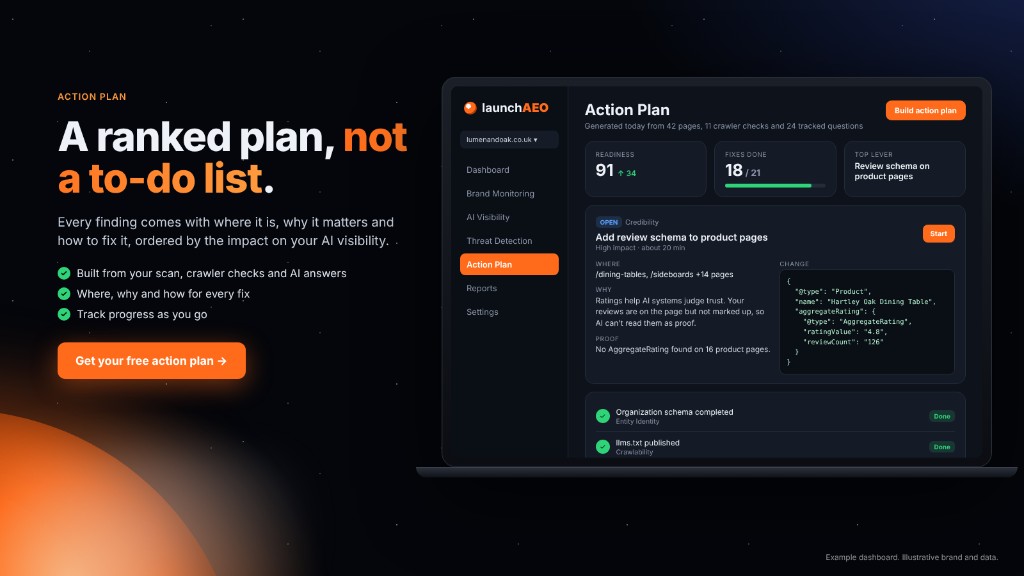
launchAEO provides an Action Plan that translates detected issues into explanations and suggested changes. For example, it can flag missing image alternative text or weaknesses in content structure and explain why those findings matter.
This helps business owners move from a technical diagnosis to practical improvements without having to interpret an unfamiliar SEO report.
Not every finding has the same impact, and no automated score should replace judgement about your actual customers and business goals.
Step 10: Measure whether your changes are working
Improving your website is not a one-off task.
Businesses change. Services change. Competitors publish new information. AI search experiences continue to evolve.
After making improvements, check whether the underlying technical issues have been resolved. Then look at the outcomes that matter to your business. These may include:
- Website readiness: Have crawlability, content structure and identity problems improved?
- Search visibility: Are more relevant pages appearing in search results?
- AI mentions: Is your business appearing in more of the relevant questions you monitor?
- Website traffic: Are visitors arriving from AI search or traditional search engines?
- Business enquiries: Are you receiving calls, bookings, purchases or contact form submissions from the customers you want?
These measures are related, but they are not interchangeable.
An improved readiness score doesn't prove an increase in customers. More AI mentions don't automatically mean more sales.
Build a useful baseline
Before making major changes, record your current position.
Save your initial website audit, list the problems identified and document the customer questions you're monitoring.
After implementing changes, repeat the checks. Compare like-for-like results rather than treating every movement in an automated score as proof of commercial improvement.
launchAEO provides free readiness auditing and action-plan features, with additional paid monitoring and reporting capabilities for businesses that need to follow visibility and performance over time.
For actual customer enquiries and sales, combine these insights with your own website analytics and business records.
How long does it take to get recommended by ChatGPT?
There is no guaranteed timeline.
Some website changes may become available to search systems after they are crawled.
Other improvements, such as building a stronger reputation, earning independent coverage or establishing a history of credible customer reviews, can take considerably longer.
Even when a page is accessible and discoverable, ChatGPT may not choose to mention it. That doesn't necessarily mean something is technically wrong.
The business might not be relevant to the specific question, stronger evidence might exist for alternatives, or the search process might retrieve different sources.
A sensible approach is to:
- Establish your starting position.
- Fix genuine technical and content issues.
- Improve relevant business information and credibility.
- Monitor realistic customer questions.
- Review results periodically and adjust based on evidence.
Avoid anyone promising that a particular schema tag, directory submission or monthly fee will guarantee a top ChatGPT recommendation.
Common mistakes that can limit your AI search visibility
Having a website that doesn't explain your services
A homepage full of slogans gives customers very little information about what you actually do. Be specific about services, products, customers and locations.
Relying entirely on Google Business Profile or directories
Third-party listings can help people find your business, but they cannot replace detailed, accurate information on your own website.
Publishing dozens of nearly identical pages
Changing only a town name or trade name rarely creates a genuinely useful resource. Each page should answer a real question and provide information specific to that service or audience.
Adding fake reviews or unverifiable credentials
Misleading information can damage trust and may violate platform policies. Use genuine evidence.
Assuming a high audit score guarantees recommendations
Technical readiness is important, but it isn't the same as actual visibility. A website can be easy to crawl while still lacking the relevance or supporting evidence needed for a particular recommendation.
Checking ChatGPT once and assuming the result is permanent
AI responses can vary. Monitor a representative set of questions rather than relying on a single answer.
Paying for large quantities of low-quality backlinks
Links from irrelevant or manipulative websites are not a reliable strategy for becoming recommended by AI. Focus on legitimate references, useful content and recognition from sources relevant to your business.
A practical 30-day plan for improving your AI visibility
You don't need to overhaul your entire website in one weekend. A structured first month can help you establish what needs attention and make measurable progress.
Week 1: Establish your starting point
Run a website audit and review the findings. Check whether your business identity, services and locations are clearly described.
Test a selection of relevant customer questions in ChatGPT and record the answers. Save your results so you have a baseline for future comparisons.
Starting tool: launchAEO free website audit.
Week 2: Improve your most important pages
Update your homepage and key service pages. Make sure they clearly explain what you offer, who you serve and where you operate. Correct missing or outdated business details. Address important technical issues identified in your audit.
Week 3: Strengthen your credibility
Review relevant public profiles and listings. Add accurate qualifications, real examples of work and useful customer information to your website. Where appropriate, ask genuine customers for honest reviews without incentives that violate platform rules. Look for opportunities to earn legitimate mentions from relevant organisations or publications.
Week 4: Recheck and measure
Run another website audit. Review which technical issues have been resolved. Repeat your original customer-question tests and compare the results.
Check search analytics and any available AI referral data. Identify what still needs work and create your next set of priorities.
The objective after 30 days isn't to guarantee a ChatGPT recommendation. It's to have a clearer, more credible and technically accessible website, supported by evidence of what has improved.
How to get recommended by ChatGPT in your industry
Different businesses need different kinds of evidence. A local tradesperson has different requirements from a restaurant, and an online software company shouldn't be assessed as though it operates a physical shop.
Explore the guidance most relevant to your business:
Tradespeople
How to improve AI recommendations
Small businesses
How to become more visible in AI answers
Builders
How to get recommended by ChatGPT
Plumbers
How to get recommended by ChatGPT
Electricians
How to improve AI visibility
Roofers
How to improve AI recommendations
Restaurants
How to get recommended by ChatGPT
Dentists
How to improve AI visibility
Garages
How to get recommended by ChatGPT
Accountants
How to get recommended by ChatGPT
Solicitors
How to get recommended by ChatGPT
Each industry has different customer questions, credibility requirements and opportunities to provide useful information.
Frequently asked questions
- Can I pay ChatGPT to recommend my business?
- You cannot purchase a guaranteed recommendation in ChatGPT's organic answers. Advertising, where available, is separate from organic recommendations and does not guarantee placement in them.
- Does ChatGPT use Google Business Profiles?
- ChatGPT may retrieve information from web sources that include business listings, depending on the search experience and available sources. A Google Business Profile is especially useful for eligible local businesses, but it is not a universal requirement for appearing in ChatGPT.
- Do I need SEO to get recommended by ChatGPT?
- Traditional SEO foundations such as accessible pages, clear content, useful information and legitimate references can support discoverability. However, strong Google rankings alone do not guarantee ChatGPT recommendations.
- Is AI optimisation different from SEO?
- AI search optimisation, sometimes called AEO or Answer Engine Optimisation, focuses on making information useful and accessible to systems that generate answers. It overlaps substantially with established SEO practices, but also encourages businesses to evaluate how they appear in AI-generated responses.
- How do I know if ChatGPT is recommending my business?
- Test realistic customer questions and record whether your business appears. Repeat those checks over time. For more systematic monitoring, tools such as launchAEO offer AI visibility features on supported paid plans.
- Can a small business compete with larger brands in AI recommendations?
- Yes, a smaller business can be relevant to a specific customer question, particularly where location, specialist services or particular customer needs matter. However, size alone doesn't determine inclusion, and strong competitors may have more extensive evidence and online visibility.
- Do backlinks help with AI recommendations?
- Relevant, legitimate backlinks can support website discovery and broader search visibility. There is no publicly established formula connecting backlink counts or Domain Authority directly to ChatGPT recommendation frequency.
- Does adding an llms.txt file help?
- An llms.txt file has been proposed as a way to present information to language-model tools, but it is not an established requirement for ChatGPT Search inclusion. Prioritise accessible HTML, clear content, working links and accurate business information before treating it as essential.
- How often should I audit my website?
- Run an initial audit before making changes and another after implementing significant improvements. Periodic checks can help identify new technical problems, but the appropriate frequency depends on how often your website changes.
- What's the best first step if my business isn't appearing in ChatGPT?
- Start by checking whether your website is accessible, whether your services and business identity are clearly explained and whether relevant supporting information exists online. A free launchAEO audit can help identify technical and content-readiness issues before you invest in further improvements.
Ready to find out whether AI can understand your business?
You don't need to be an SEO specialist to start improving your business's visibility.
You need to understand what your website currently communicates, identify genuine problems and make improvements that help customers and search systems find accurate information about your business.
That's what launchAEO is built to help with.
Start with a free website audit. Check your AI Search Readiness score, explore the findings behind it and use your action plan to identify what to improve.
When you're ready to go further, explore additional AI visibility monitoring and reporting features to help understand how your business appears across supported AI platforms.